Words Alive Brand Promise

By Patrick Stewart, Executive Director

Words Alive won.jpg

In September, board member Kim Harrison, and her husband, brand specialist Doug Harrison spent two long, yet fulfilling days with the organization identifying how best to convey its brand – in the simplest terms: what do we do, how do we do it, what are the results, and what does that look like, 20 years young, in the community. We discussed our heritage, personality, symbolic cues, self-reflexivity, functional benefits, and self-expressive benefits.

This exercise has resulted in not only a language that better describes who we are and what it means for all of us to be touched by Words Alive, but a refreshed logo which highlights the action and activity that our engaging reading programs ignite in young people and their families – a logo we are happy to present publicly for the first time here.

Our new logo reflects the activity that happens in the classroom through each of our programs. We are an organization that brings words alive! We place caring adults in classrooms that create an environment where learning is fun and exciting, and important connections are made between books and the world around the students and families we serve. The circle represents the important back and forth dialogue we promote in all our programs, ensuring that each of our participants has a voice. It also represents the change that happens in each of us as we engage with Words Alive.

This process has permeated all aspects of the organization – from deep examinations of our programs, to how we market those programs, how we celebrate and leverage the community partners with whom we deliver the programs, to how we now look to the future – how Words Alive grows and spreads this impact to every corner of our San Diego community and beyond.

The key theme of our new brand promise recognizes that Words Alive changes the story of your life. Whether you are a donor, volunteer, participant, or all the above, Words Alive has a meaningful impact on your life story. At Words Alive we are committed to creating engaging and equitable experiences that open pathways to success. Below is the brand wheel that represents the key pieces of our identity and values around the brand promise.
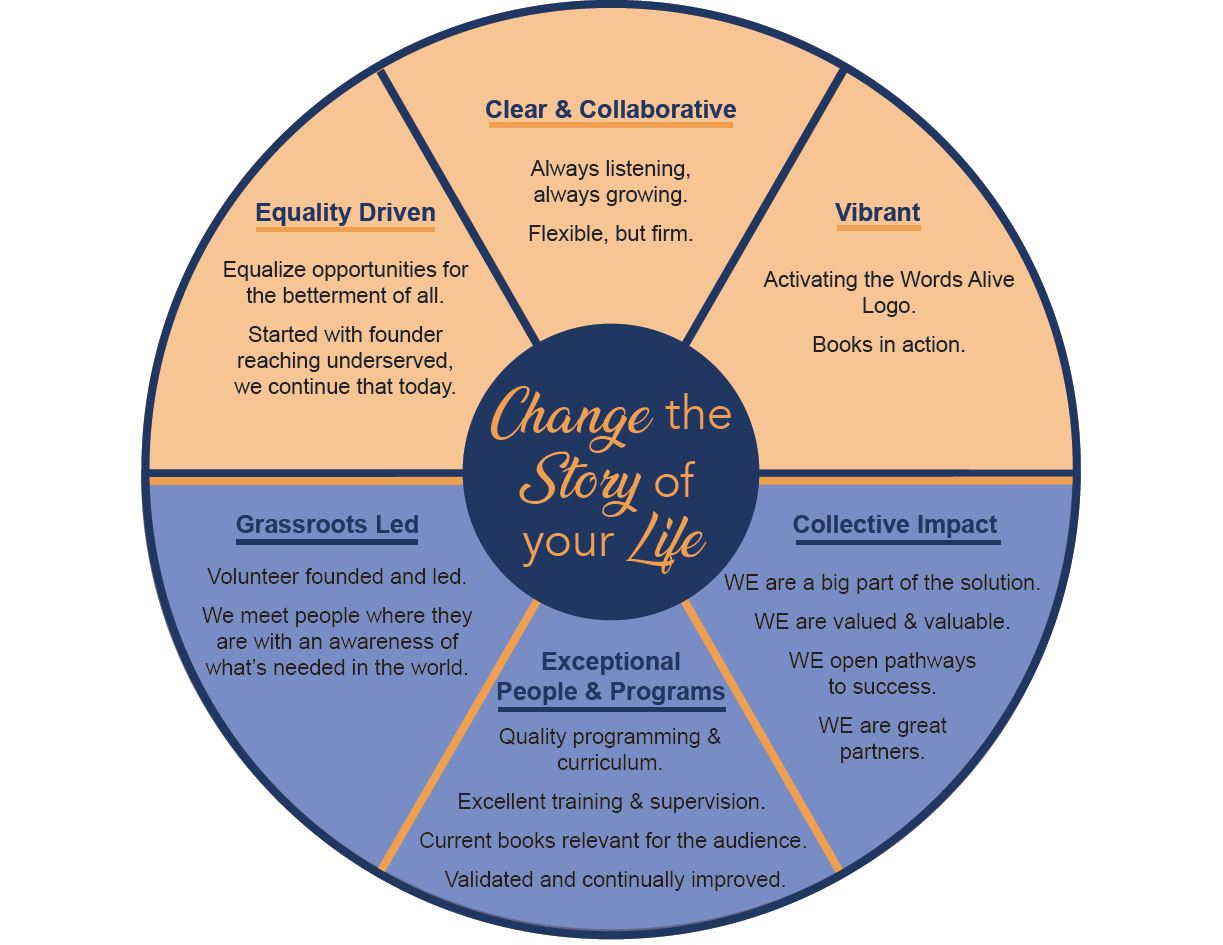
Brand Wheel.JPG


Social Emotional Learning

By Tait Loghi, Blog Intern

Many of you reading may be asking, “what is social emotional learning (SEL)?” Well, according to the Committee for Children it is defined as, “the process through which children and adults acquire and effectively apply the knowledge, attitudes, and skills necessary to understand and manage emotions, set and achieve positive goals, feel and show empathy for others, establish and maintain positive relationships, and make responsible decisions.” This type of learning promotes several areas of development for the next generation as they get older. For example, empathy, communication, emotional control and management as well as assertiveness are traits that are championed and taught through this method.

Starting back in 1995 with the rise of funding and interest in SEL, and by the beginning of the 2000s, SEL had been implemented in schools in all 50 states as well as internationally. In over two decades of SEL teaching, many studies have been conducted and they have found some amazing results. According to CASEL,  a “2011 meta-analysis of 213 studies involving more than 270,000 students, those who participated in evidence-based SEL programs showed an 11% point gain in academic achievement.” Clearly, SEL makes a drastic difference in learning for the children.

Here at Words Alive, we understand that the benefits of reading are multi-faceted and extend way beyond meeting literacy benchmarks. Children explicitly learn social and emotional skills through reading!

According to the article “Tips to Incorporate Social-Emotional Learning Into Everyday Literacy Instruction” SEL and reading can “serve as a model of how...Resilience, in particular, is a core SEL skill that translates well across subject areas”. Through reading, children and young adults learn how to be resilient, how to empathize with others, and how to believe in yourself.

Sources:

https://www.cfchildren.org/about-us/what-is-sel/

https://casel.org/what-is-sel/

How Reading Inspires Communities

By Tait Longhi, Blog Intern

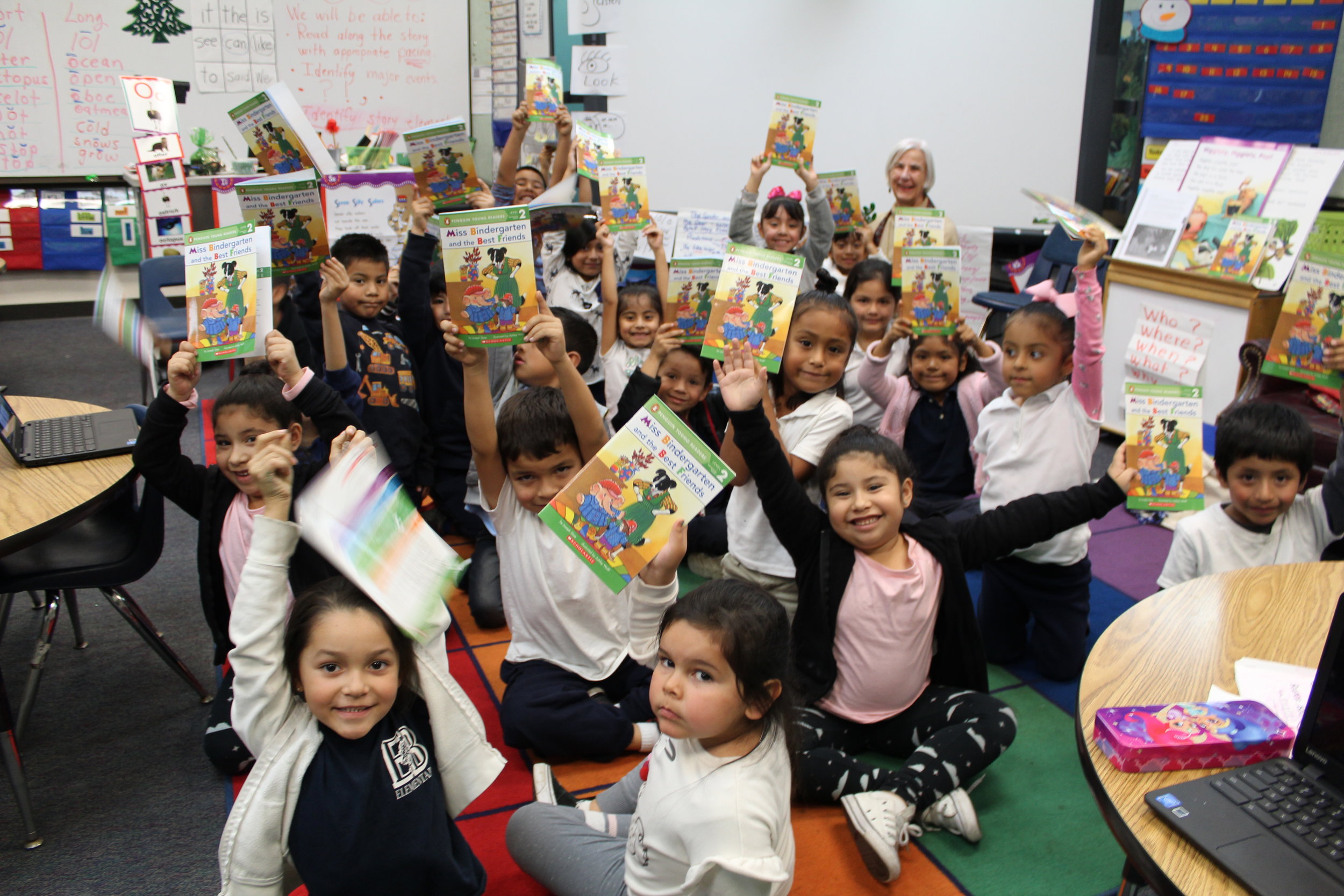
An image of a group of students in our Read Aloud Program excitedly holding up their books.

An image of a group of students in our Read Aloud Program excitedly holding up their books.

There are countless reasons why two strangers may connect, but one common reason that has connected all ages is the commonality of stories. As a child, when you discover that your classmate loves the same book series as you, an immediate conversation ensues. Being able to talk about characters, what they think will happen next and why they love the book as much as you do creates a bond.

This doesn’t go away with childhood, if anything it intensifies. Reading doesn’t only builds friendships, but entire communities. Words Alive, organizations like the Harry Potter Alliance (HPA), GoodReads or just a classic book club are just a few examples of how the power of reading can bring people together. It may be the fact that every person reading the pages will take a different lesson or viewpoint than the next, and we as humans desire to know and understand one another through these insights.

Books also teach us life lessons that inspire us to do something good for our community. Organizations like the Harry Potter Alliance were founded out of a love for the Harry Potter series and have created a whole community of activists who are using popular stories to change the world. John and Hank Green are brothers (and both authors) who have fostered an online community called Nerdfighteria, a community that celebrates many things but chief among them is a love for books and learning. With the internet, it’s easier than ever to find and form communities around a love of books.

According to the journal, “Using Parent Book Clubs to Build a School-Wide Reading Community”, a high school class partook in reading aloud throughout the year. This allowed students to “engage in meaningful relationships and social interactions tied to reading, and these connections mattered to them. Students took these connections seriously, and they authentically acted in ways to contribute positively to the reading community.” Here, we can see what one could call book club within the classroom.

The importance in these communities may seem obvious, but there is more than just reading aloud and discussing books. Organizations like Words Alive understand that communities that value reading help build thriving and intellectual individuals and relationships among one another.  

Reading, literacy and all it brings is a powerful thing, which is why we at Words Alive are here. Through the passion of reading we have come together to show the importance and positive impact it can make on others. While reading is often done in solidarity, it has the unique ability to bring a huge group together, to understand and bond with one another.  


WAWS Spotlight: Lexi Martinez!

An image of Lexi (left) with our Teen Services Program Manager Jessica Fryman at the 2018 WAWS Scholarship Award Ceremony.

An image of Lexi (left) with our Teen Services Program Manager Jessica Fryman at the 2018 WAWS Scholarship Award Ceremony.

"My experience with Words Alive has always been extremely positive. My love for reading has been restored since I have been involved with them and I've always found a support system within the organization." -- Lexi Martinez, Words Alive Westreich Scholar

The Words Alive Westreich Scholarship Program awards scholarships to participants in the Words Alive Adolescent Book Group to support them in their pursuit of higher education at the college or vocational level. Unlike other scholarship programs, which typically fund only tuition, books and educational supplies, each recipient is eligible to receive funds to cover the cost of rent, food, childcare, clothing, travel and other living expenses. Additionally, the program matches each recipient with a mentor. Student and mentor meet regularly throughout the school year, and the mentors provide guidance, direction, and often, a shoulder to lean on.

Let’s hear more from one of our scholars: Lexi!

Name: Zaira "Lexi" Martinez

Age: 23

College: San Diego State University

Degree (with area of study): Social Work

Mentor: Sarah Beauchemin

How did you first get involved with Words Alive?

I first got involved in Words Alive when I became a student at Monarch. Reading has always been an escape for me and after my family and I were left without a stable home when my mom divorced her abusive husband, Words Alive provided an escape for me. I loved all the books we read, the discussions, and finding out which book we were going to read next. Once again, books became an escape for me and I loved being a part of a community of open and like minded individuals. 

How has your experience with Words Alive affected you?

Looking back and reflecting on where I am, Words Alive has positively affected my academic career in many ways. In high school there was a time where I did not see myself going to college or making improvements to my life but the volunteers always pushed me to do my best. The books we read were stories about resilience and overcoming obstacles made by others and ourselves. They were stories that were so relatable to my own life and it made gave me the strength to discover a better life for myself. I always felt like I belonged and someone knew how to empathize with what I had been through. After I received my scholarship, I was so motivated to do better because I knew someone believed in me and I did not want to disappoint. All of the workshops that we have done have taught me life skills and my meetings with my mentor are outings that I anticipate so I can tell Sarah all of my plans and exciting news that happened that month. I am so proud of the person that I have become with the help of my Words Alive family. 

What have you accomplished this year that you are most proud of?

This year I have accomplished, with the help from Sarah, a more organized academic schedule which includes writing more in my planner, forming professional relationships with my professors, living a healthier lifestyle, and working on self-care. We made this plan in the beginning of the semester and I feel like a better person. I no longer stress too much from my heavy course-load because of how evenly distributed it is. I also have much more time to dedicate to myself and my family. 

What is your favorite college memory so far?

My favorite college memory is transferring from San Diego City College to San Diego State University. Until a few years, higher education was not even on my radar but now I am in my dream program enjoying all the possibilities laid out in front of me and it is overwhelming in the best way. I can't even imagine where I would be had I not come to Monarch and been a part of Words Alive. 

What are you currently reading?

I am currently reading Sharp Objects by Gillian Flynn. I watched one episode of the show and I was so enthralled by it that I wanted to read the book first. 


Learn more about the WAWS program here and donate today to help us keep this scholarship going!


WAWS Evaluation Finding #8: "I believe in my future."

A group photo of our scholars at the 2018 Words Alive Westreich Scholarship Award Ceremony.

A group photo of our scholars at the 2018 Words Alive Westreich Scholarship Award Ceremony.

To continually provide meaningful and evaluation-driven programming, Words Alive commenced on a seven-month Dialogues in Action (DIA) project to analyze the impact of our Words Alive Westreich Scholarship (WAWS) program using a blended qualitative and quantitative evaluation model. Through this process, we had an opportunity to view our program through the lens of the scholarship recipients, past and present, and their mentors to determine opportunities to enhance our program delivery.

Throughout this process, we identified eight findings and then brainstormed ways we could update and improve the program based on these findings. Here is the eighth and final finding!

"I believe in my future."

All scholars in the program are graduates of Juvenile Court & Community Schools, which serves a student body experiencing extraordinary challenges such as juvenile delinquency, homelessness, community violence and/or teen parenting. Because of this, they are often focused on the present, getting through day-by-day and making sure their basic, immediate needs are met. Through our interviews with participants and mentors, we found that many of the scholars made clear connections between participating in the program and a discovered or renewed focus on their future. In fact, 92% of the students said they now feel more hopeful about their education and future.

Due to the extraordinary circumstances these students come from, scholars often felt as if they were not in control of their own lives but were instead trapped by their upbringing and environment. However, we found that after participating in the program, the financial, mentor and professional development aspects of the program have helped scholars believe in themselves, their futures and their abilities — creating a sense of agency over their personal and academic trajectory. This translates to students taking action toward improving their future.

 After participating in the program,

  • 85% of scholars said they now use coping strategies to address challenges they face

  • 85% of scholars said they now take action steps toward the goals they set

  • 100% of scholars said they the now take advantage of academic, professional and community resources

Mentors recognize this growth too:

“I think she sees each of these accomplishments as milestones – and they are. It supports her sense of self-worth, value and confidence. For some people, it’s easy, but for her it has been incredibly challenging. Every single milestone increases her confidence. And she’s facing this hurdle now but she’s not going to give up.”

Two scholars mentioned they actively plan ahead in terms of applying for additional scholarships, saying, “I’m saving scholarships for further down the line” or “I’ve been going over my statements more. I figure out when different scholarships are coming in and when the deadlines to apply are.”

“I had never saved money before and the scholarship program taught me how to…I’m planning on buying a house. Not anytime soon but hopefully in 10 years or so,” another scholar said. “I have the skills to save money now and the motivation to buy a house.” – Scholar, age 24

This same scholar, when asked about how she dealt with challenges, such as persistent mental health issues, throughout her college career said, “I realize I have to focus on my future. The depression and PTSD were because of my past experiences. I learned that I could change things now, so I won’t be in the same situation later on. I need to believe in my future.”

Significance

At Words Alive, we want participants in all of our programs to become advocates for themselves and their future, especially so in the WAWS program. This finding indicates that through program participation, scholars are learning to proactively contribute to their own personal development by creating long-term goals and that they’re making steps towards meeting them. This is not only significant to the individual student but to the larger community. By becoming individuals who are no longer just getting by day-by-day, they are prepared to contribute to local economies, culture, politics, and to help their communities thrive.

Learn more about the Words Alive Westreich Scholarship here!


WAWS Evaluation Finding #7: The Mentee Becomes the Mentor

An image of three of our scholars, Zaphire, Domminiece, and Lexi, standing together at the 2018 Words Alive Westreich Scholarship Award Ceremony.

An image of three of our scholars, Zaphire, Domminiece, and Lexi, standing together at the 2018 Words Alive Westreich Scholarship Award Ceremony.

To continually provide meaningful and evaluation-driven programming, Words Alive commenced on a seven-month Dialogues in Action (DIA) project to analyze the impact of our Words Alive Westreich Scholarship (WAWS) program using a blended qualitative and quantitative evaluation model. Through this process, we had an opportunity to view our program through the lens of the scholarship recipients, past and present, and their mentors to determine opportunities to enhance our program delivery.

Throughout this process, we identified eight findings and then brainstormed ways we could update and improve the program based on these findings. Here is the seventh finding!

The Mentee Becomes the Mentor

We were surprised to find that through participating in the program and developing a relationship with their mentors, our scholars in turn became mentors for their peers.

When asked what they were passionate about, six out of nine of the scholars interviewed said “helping people.” Many of the scholars are pursuing careers such as social work, therapy, and child development with the ultimate goal of helping youth that have similar stories to their own.

In addition, many of the scholars spoke directly about becoming mentors for their peers. One scholar said:

“Now, I pass on the advice my mentors have given me to other people. I’m a mentor for some of the students at Lindsay because I’ve been in their shoes. It’s good to share your experience because they can see a role model and can relate to you. It gives them faith that things will work out… I just try to be a helping person and when someone’s experiencing a lot of emotions I try to be a calming presence like the calming presence my mentors have been for me. I’ve learned to ask for help and people still ask me for help.” – Scholar, age 22

It's clear from this example and others that being a mentor wasn’t necessarily an innate skill the scholars possessed, but something they learned through their relationship with their WAWS mentor. This statement from one of our scholars illustrates the range of skills these students learned from their mentors:

“I valued [my mentor’s] honesty. She would be upfront but in a professional way. I learned how to be that way with other people. ‘Let’s go grab coffee’ is not something I had done before but now do with other people.” – Scholar, age 24

Significance

One of our intended impacts for this program is that scholars form healthy and meaningful relationships with their peers and adults. Because of their upbringing, many of our scholars lack healthy adult relationships in their lives. To see the students develop relationship-building skills and then become a mentoring force in their community is significant because it proves that the scholars can learn the basic tenets of a healthy relationship and give and take in positive ways in those relationships.

Learn more about the Words Alive Westreich Scholarship here!


Read Across America 2019!

By Jennifer Van Pelt

A graphic featuring the text “Read Across America” underneath an image of the hat from Dr. Seuss’s “The Cat in the Hat.”

A graphic featuring the text “Read Across America” underneath an image of the hat from Dr. Seuss’s “The Cat in the Hat.”

Read Across America Day falls annually on March 2nd. The holiday was initially founded by the National Education Association (NEA) as a small way to help advocate for the importance reading among children by making it an exciting celebration. Twenty one years later, 3.3 million NEA members support the event. The holiday, which falls on Dr. Suess’s birthday, aims to motivate children to read more at a young age with the goal of creating lifelong successful readers.

The U.S. Department of Education found that, generally, the more students read for fun on their own time, the higher their reading scores. To help encourage this behavior, the NEA comes out with a digital literacy calendar with suggested books for various reading levels that coincide with holidays, events, or unique topics. Included in this calendar is also a list of suggested activities and resources to make reading a more engaging experience. The National Center of Education also found that children who were read to frequently were more likely to count to 20 or above, write their own names, and read or pretend to read, are all very important skills. Integrating reading into a child’s daily routine is imperative to creating a basis to build upon as they grow older.

As a day that is celebrated in many schools, libraries, and community centers, it’s a great opportunity to incorporate Dr. Suess and his incredibly popular children’s books. Thirty years after his passing, his books are still some of the most recognizable, visually intriguing, and entertaining books to read for children and adults alike. As an author who had fun with words and sounds, he helped children get comfortable with phrases they were unfamiliar with. Lines such as, “Then he hides what you paid him away in his Snuvv, his secret strange hole in his gruvvulous glove” encourage both adults and children to use context clues to figure out the meaning of “snuvv” or “gruvvulous” and how they work within the sentence.

Aside from encouraging children to infer, Dr. Seuss also included a lot of lessons in his books. From teaching children about treating the Earth with respect and the importance of sustainability in The Lorax to classics such as The Cat in the Hat, he was able to incorporate a lesson, big or small, into the book. The Cat in the Hat, perhaps one of his most iconic books, is featured in Read Across America media and the hat is even sold with some purchases to bring the celebration full circle.

Read Across America is a great way to help children get excited about something they may often associate strictly with school. Words Alive firmly believes that by extending the spirit of this celebration into an everyday commitment, it has the power to improve lives for the better. If you would like to learn more about the various ways we make reading fun and accessible to children of all ages, click here.

Board Spotlight: Jeffrey Goldman

Jeffrey 2.jpg

Meet Jeffrey!

Jeffrey Goldman has been a part of the Words Alive family since 2014 and most recently completed his tenure as Board Chair on the Words Alive Board of Directors. Over the past five years, Jeffrey has been a constant source of leadership and inspiration through his commitment to Words Alive and bettering the futures of students in our programs. Jeffrey not only serves on the board, but also volunteers with our Adolescent Book Group as a writing facilitator at the Monarch School.

Jeffrey is the publisher at Santa Monica Press, an independent book publishing company, since he founded the press twenty-five years ago. Santa Monica Press publishes an eclectic list of critically acclaimed and award-winning non-fiction books. Prior to Santa Monica Press, Jeffrey spent a decade as an arts and entertainment journalist and editor, working for a variety of newspapers and magazines both nationally and internationally.

In addition to serving on the Words Alive Board of Directors, Jeffrey is also a member of the Board of Trustees at the La Jolla Playhouse, where he serves on the Executive Committee and is the chair of the Education and Outreach Committee.

I wanted to make an impact on the lives of children and believe that encouraging strong reading and writing skills is the simplest and most effective way to change the story of a child’s life.
— Jeffrey Goldman

Now, let’s hear more directly from Jeffrey!

How has Words Alive changed the story of your life?

Words Alive has changed the story of my life by making me aware of not only the extraordinary need in the community for advocates of reading and writing, but also of the number of incredibly talented children — brilliant writers — whose talent often slips under the radar of their parents and family members. The joy and fulfillment I receive from helping to spread the love of reading and writing to children, and further encouraging those children who already show a tremendous aptitude in these areas, has brought me endless pleasure and has truly changed the story of my life.

When was the first moment you fell in love with reading?

I remember reading a book (whose title I’ve long since forgotten) with my teacher and fellow classmates in kindergarten or first grade. It was a mystery of some sort, and before we turned the page to find out the surprise ending, the teacher asked us if anyone could guess what was going to happen. I guessed correctly, and the shock, surprise, and wonderment on her face gave me so much happiness and confidence that I couldn’t wait to read the next book she assigned! My love of reading (and writing) kicked into high gear from that point on!

How do you use literacy in your day-to-day life?

As a book publisher, writer, and editor, I not only use literacy in my day-to-day life, it has been my profession and my passion for 40 years.

Jeffrey working with an Adolescent Book Group student at Monarch School.

Jeffrey working with an Adolescent Book Group student at Monarch School.

What is your favorite book and why?

This is a nearly impossible question to answer because there are so many. Certainly Shakespeare and William Faulkner top the list of my favorite authors, and King Lear and As I Lay Dying are my two favorite works by these amazing writers. If forced to choose, I guess I’d go with King Lear. Why? Because it’s such a powerful, tragic story that encapsulates so much of the human condition.

What made you join the Words Alive board?

I wanted to make an impact on the lives of children and believe that encouraging strong reading and writing skills is the simplest and most effective way to change the story of a child’s life.

What has been your favorite aspect of being a Words Alive board member?

Working with the kids in the classroom; working with and becoming friends with the incredible Words Alive staff, volunteers, and my fellow board members; and being a champion of Words Alive out in the community.


Thank you, Jeffrey, for all you’ve done for Words Alive! Learn more about our Board of Directors here!

Finding Your Passion in College

By Grace Larsen, Guest Blogger

Image of a person standing in the middle of a library aisle, looking at a book that they are holding open.

Image of a person standing in the middle of a library aisle, looking at a book that they are holding open.

College can be daunting for many students as there is a lot of pressure to be “career ready.” Words Alive previously explored what exactly that term means, and it entails having the tools to obtain a job after graduation as well as being prepared to pursue apprenticeships and on-the-job training. Of course, all that is easier said than done. In order to be career ready, one must have a clear picture of the future they want to begin with. 

Therein lies the problem: for many of us, knowing what we want to do before stepping into college is far from easy. In fact, according to figures by the National Center for Education Statistics, about 80% of college students change majors at least once. Another study found that students who started out in mathematics and natural sciences are more likely than others to make a switch. Each student has their own personal reasons for changing majors, but a common denominator is that they realized a little too late that their interests lie elsewhere.

All in all, switching majors has its pros and cons. One advantage is that you’ll be more satisfied knowing that you pushed through with exploring the path you really want. Changing majors also widens your knowledge of other areas of study because of the fact that you’ve taken classes in more than one department. However, the biggest con is that your college expenses can very easily rack up. Another is that you won’t be able to graduate on time, and will be spending more time in school instead of embarking on your career. 

This is why guidance counselors and teachers grill high school students about “finding their passion” so early in life: so that they can pursue their chosen fields and stick with them until graduation. Unfortunately, aiming to discover one's passion is actually the wrong mindset. To better understand why, let's take a look at a study by psychologists from Stanford University and Yale University, which points to two different theories. The “fixed theory of interests” is the idea that core interests are there from birth and are just waiting to be discovered. Meanwhile, the “growth theory” posits that interests are something that a person cultivates over time. 

These psychologists explain that students with the first mindset may waste their time skipping opportunities and foregoing lessons that aren’t aligned with their previously stated passions. Also, if a person is told that their interests are ingrained, they may easily give up on learning certain topics because of the belief that these don’t align with their predetermined interests.

Therefore, high school students shouldn’t start college applications thinking about finding their passions, but rather, to develop them. With the second mindset centered on growth, one can increase their knowledge in areas outside of pre-existing interests. In contrast to those with a fixed mindset, they would then form connections among new areas and the interests they already have. 


For a start, Maryville University provides some key pieces of advice on how to choose a degree program or area of study. They emphasize the importance of knowing a particular field’s median salary, projected growth, and the percentage of bachelor’s degrees awarded annually. Information like this can help you check whether you see yourself in a particular field years from now. You can then proceed to researching school options as well as other things like costs and location.

Again, it's important not to feel overly pressured to know for certain what you love and will continue to love in the future. It’s healthier to believe that passion is something that you create. This helps you tackle your chosen field with a more determined approach, and shapes how you will learn along the way. College may expose you to a number of challenges and obstacles, but a growth mindset can keep you focused on building your passion.

Learn more about our work with college students through the Words Alive Westreich Scholarship program here!

Life Lessons Learned From Popular Children's Books

By Jennifer Van Pelt

An image from The Lorax by Dr. Seuss. The Lorax is standing on a tree stump and text on the images says, “‘Mister!’ he said with a sawdusty sneeze, ‘I am the Lorax. I speak for the trees.’”

An image from The Lorax by Dr. Seuss. The Lorax is standing on a tree stump and text on the images says, “‘Mister!’ he said with a sawdusty sneeze, ‘I am the Lorax. I speak for the trees.’”

If you think back on some of your favorite books as a child, or the books you read to your own family members and loved ones, there’s likely some stories or motifs that stick out in your memory. Examples of popular themes in children’s books include not getting to bed on time and all of the chaos it can create, what eating too much food can cause, or why being nice to siblings can bring positive experiences. These subtle themes introduce new ideas to children as well as humanize lessons for them.

Some books take these lessons even further by relating them to some of the “Golden Rules” or basic social skills that children should learn when they are young. Aesop’s Fables is perhaps one of the most famous for popularizing these ideas for children, but it’s a common practice among popular contemporary children’s literature. Take a look at some of the examples below that you may have not realized subtly suggest a larger life lesson to children.

“The Rainbow Fish” by Marcus Pfister follows the story of a beautiful rainbow fish who keeps his beautiful scales to himself instead of sharing them with the other fish, leaving him with no friends. By the end of the book, the fish learns that giving the other fish some of his scales made him friends, thus embodying the “sharing is caring” motto we often teach children.

“Corduroy” by Don Freeman depicts the story of a teddy bear who goes on a hunt for his missing button that he believes he needs for any child to love him enough to buy him. After an adventure-filled and fruitless excursion for another button, a little girl buys him and loves him for his flaws. This book touches on the lesson that no one is perfect and everyone has flaws; it’s just about learning to love yourself as you are.

No children’s book list would be complete without a book from Dr. Seuss. “The Lorax”, perhaps one of his more popular and pertinent books, is a cautionary tale about treating the Earth with respect. It follows a child and his discovery to how his previously breathtaking town came to become such a desolate and destructed area. This book not only teaches children about the importance of sustainability and moderation, there’s also an overarching theme about the importance of learning from the past.

Words Alive knows that there are countless more benefits to reading aloud to children. In addition to introducing life lessons to them, reading aloud can also support their overall knowledge of books in general, cadence of reading a book, and vocabulary. If you would like to support our journey in ensuring more children are able to participate in the experience of reading aloud, you can visit our Read Aloud Program homepage here to learn more.