by Vichittra Chaleune
Words Alive began with one program built around a simple idea, that everyone deserves the opportunity to explore books in a brave space and connect with others.
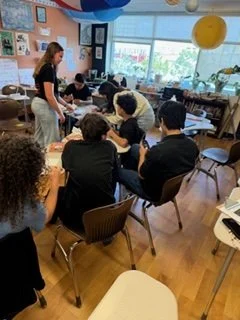
Volunteer Sarah Song at Monarch School
Our founder was a social worker who had loved books her whole life. She'd seen how the conversations in her own book clubs could change people, with honest talk, laughter, and the feeling of being understood by someone who'd read the same pages. She wondered if those conversations could do the same for teens who were too often overlooked. In 1999, she set out to find out.
Words Alive began in one classroom at the Lindsay Community Day School in San Diego, an alternative school serving pregnant and parenting teens. The students showed up, opened up, and showed us the idea worked. As a result, we built curriculum, training materials, piloted the program there, and the Adolescent Book Group (ABG) became our flagship program. Every program we offer today, from birth through high school, grew from the idea of connection through the power of books.
Over the years, ABG has been collaborating with the San Diego County Office of Education, the Juvenile Court & Community Schools, San Diego Unified School District, and local colleges and universities. Together, we reach resilient young people carrying heavy loads, including housing insecurity, food scarcity, trauma and violence. ABG gives them a platform to be heard and to belong.
This year, new cohorts of students at The Monarch School and San Pasqual Academy will continue to gather around books finding ways to talk, explore, and connect through shared stories. Our circle continues to grow, and for the first time in Words Alive history, ABG will expand to young readers at Pacific View Leadership Elementary, Perry Elementary, and Valencia Park Elementary.
The need is real. Nearly half of San Diego's students aren't meeting reading and language arts standards, and students from historically under-resourced communities feel that most. ABG responds with books students can see themselves in, and with conversations that reach beyond the page and into their lives. As one Monarch student shared with us, "I love how we talk about our point of views, not just the books. It was fun sharing different opinions." Our surveys tell the same story. About 80% of students said ABG helped them express themselves through writing, and nearly 84% said it helped them connect what they read to their own lives.
National research points in the same direction. A recent Education Week report found that teens and tweens are reading less for pleasure, and that educators widely report students' reading stamina has slipped in recent years. But the same report highlights what helps: reviews of research on reading motivation show that students are more motivated when reading is social, when they get to talk with peers about the book, and when the stories feel relevant and important to their own lives. That's the heart of ABG. Every session is built around shared stories and honest conversation, giving young people a reason to keep turning the pages.
Teachers see it too. In 2025, an educator at San Pasqual Academy sent us this note.
"I meant to e-mail you to express how pleased we are with our volunteers. Their enthusiasm and engagement have greatly enriched the students' learning experience. Their ability to connect with the students and meet them at their level has been incredibly impactful. They not only encourage thoughtful discussions but also ask relatable questions that resonate with the students' experiences. This support fosters a more engaging and meaningful learning environment. We would like to request them back for years to come."
And our volunteers feel it. One longtime facilitator at Monarch remembers a student who barely spoke during his first year, then began leading discussions in his second. "Watching him gain confidence and share his ideas is inspiring!"
Moments like that happen because caring adults keep showing up. Through 27 years, one belief has stayed with us: when young people read together and talk honestly about what they've read, they begin to see that their own story can change.
Sources
• Getting Middle Schoolers to Do the Reading Is Hard. Can Communal Reading Help?, Education Week, October 19, 2026