By Melinda Casey, Director of Learning and Engagement
Compassion is a verb.
— Thich Nhat Hanh
Close your eyes for a second. Okay, keep reading, but pretend.
Think of a time somebody did something small for you that you weren’t expecting. Somebody saved you a seat or caught the door for you before it swung shut. You got a handwritten note in the mail or a voice message from an old friend checking in.
Notice what your body's doing right now, remembering that. Chest a little warm? Maybe the back of your throat too?
Scientists have a name for that. They call it elevation, and researchers at UCLA have watched it happen in thousands of people: warmth in the chest, goosebumps, sometimes tears, just from witnessing someone be kind to someone else. [1]
That's how fast kindness moves through a body.
This year our theme is Play it Forward: Stories of Kindness, built on that same idea. Kindness ripples as a pebble dropped into water.
Here's how far it travels.
Preschoolers who get more time for free play score higher on empathy and lower on disruptive behavior. Play is where kids first practice reading a room full of other people. [2]
Kindness works the same way when kids practice it on purpose. Put nine- to eleven-year-olds through four weeks of doing three kind things a week, and by the end they're more accepted by their peers than kids who did something else entirely. [3]
Teenagers show the same pattern. A seven-day, student-led, pay-it-forward kindness challenge, run by kids for kids with no adults involved, raised participants' happiness by a wide, statistically real margin. [4]
The effect travels past the person you were kind to. Researchers studying cooperation in social networks found it spreads three degrees out: to your friend, to your friend's friend, to somebody you will never meet and never know you affected. [5]
A kid being kind at recess today is doing something that reaches people they will never meet.
Every year we ground our reading lists in one theme, and every program builds a full year of titles around it. Here are a few examples of what we have in store for young readers this year.
Let's Read Family Literacy Program
It's Okay to Be Different by Todd Parr
Todd Parr states it plainly. Different color, different family, need glasses, need help, feel big feelings — it's all okay. This fun book gives families an easy way to name what makes them unique and treat it as ordinary.
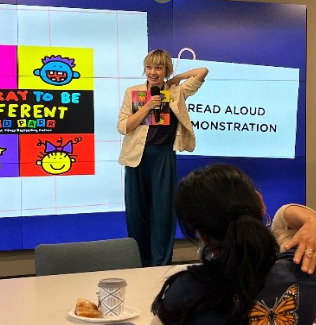
Figure 1: When I read this book aloud at trainings, I remind childcare workers to play and have fun along with the kiddos (and also how to say “Thank you, me!”) by patting ourselves on the back for being great readers.
Read Aloud Program
Red: A Crayon's Story by Michael Hall
Red is a blue crayon wearing a red label, spending the whole book failing at being red. Everybody around him tries to fix that. One friend asks him what he can do instead. Paying attention helps him more than fixing ever did.
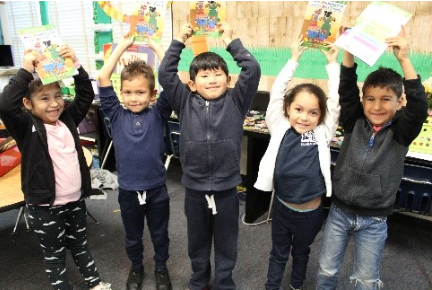
Figure 2: Happy readers hold their new books high!
Book Group
Hunger Action Heroes Unite! developed by Feeding San Diego
Our Book Group scholars at Valencia Park and Perry Elementary, in partnership with SAY San Diego, work with something literal this year: food insecurity in their own neighborhood. Hunger Action Heroes Unite! hands them something to do about it. Play shows up as the hands-on activities built into every session. Kindness shows up as an nine-year-old deciding she can help somebody now.
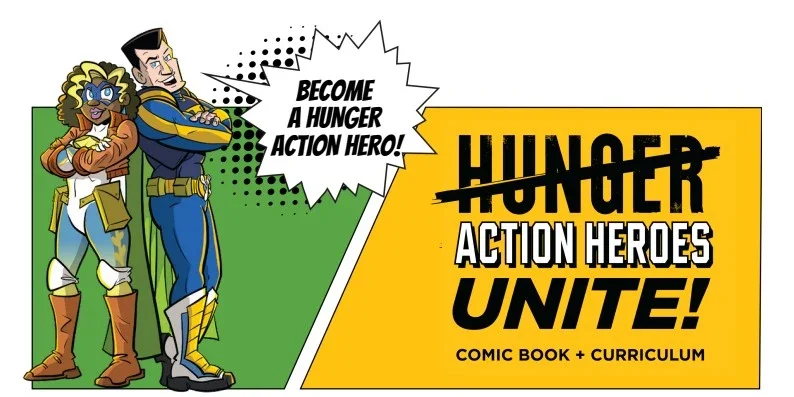
Figure 3: The superheroes who help students learn about food justice through project-based learning.
To learn more about this special programming, visit https://hungeractionheroes.org.
Every program's full reading list this year, Family Literacy, Read Aloud, and Book Group alike, carries the same idea in books built for different ages.
Compassion is a verb, like Thich Nhat Hanh said, and a person who practices it starts a ripple: it reaches a friend, then a friend of that friend, then somebody we’ll never meet.
I want to be a part of that ripple, and I want you to join me. Be part of the movement to make reading matter: become a volunteer at wordsalive.org/becomeavolunteer, or give the gift of reading at wordsalive.org/donate.
Play it forward, y'all.
References:
[1] UCLA Bedari Kindness Institute. (2023). Is kindness contagious? UCLA Newsroom. 8,000 participants across 15 experiments.
[2] Veiga, G., Neto, C., & Rieffe, C. (2016). Preschoolers' free play: Connections with emotional and social functioning. International Journal of Emotional Education, 8(1), 48-62.
[3] Layous, K., Nelson, S. K., Oberle, E., Schonert-Reichl, K. A., & Lyubomirsky, S. (2012). Kindness counts: Prompting prosocial behavior in preadolescents boosts peer acceptance and well-being. PLOS ONE, 7(12), e51380.
[4] Hu, N., & Domb, L. (2024). Student-led kindness intervention boosts high school students' well-being. Journal of Student Research, 13(3).
[5] Fowler, J. H., & Christakis, N. A. (2010). Cooperative behavior cascades in human social networks. Proceedings of the National Academy of Sciences, 107(12), 5334-5338.